
Outdoor conversations have their own vocabulary. If you shop for equipment in English, watch hunting or hiking videos, or talk with people who spend time in the field, you will hear words that rarely appear in a basic textbook.
This guide explains useful hunting and outdoor gear terms in natural English. Each word includes a short meaning and an example you could hear in a real conversation.
Basic Carrying Equipment
Pack / backpack — A bag carried on your back.
Example: Keep your rain jacket near the top of your pack.
Strap — A long, narrow piece of material used to hold, carry, or fasten something.
Example: Tighten the shoulder straps so the backpack does not move while you walk.
Sling — A strap or carrying system used to support equipment such as a rifle or crossbow.
Example: He adjusted the sling before starting the long walk uphill.
Hands-free — Describes equipment that can be carried or used without occupying your hands.
Example: A hands-free setup makes it easier to climb and keep your balance.
Quick-release — Designed to open or detach quickly when needed.
Example: The quick-release buckle can be opened without removing the entire pack.
These terms often appear together in product descriptions. For example, the Stalker Sling is described as a hands-free carrying system for a rifle or crossbow, with quick-release access for use in the field. Reading real product pages is a useful way to see how practical outdoor vocabulary is used in context.
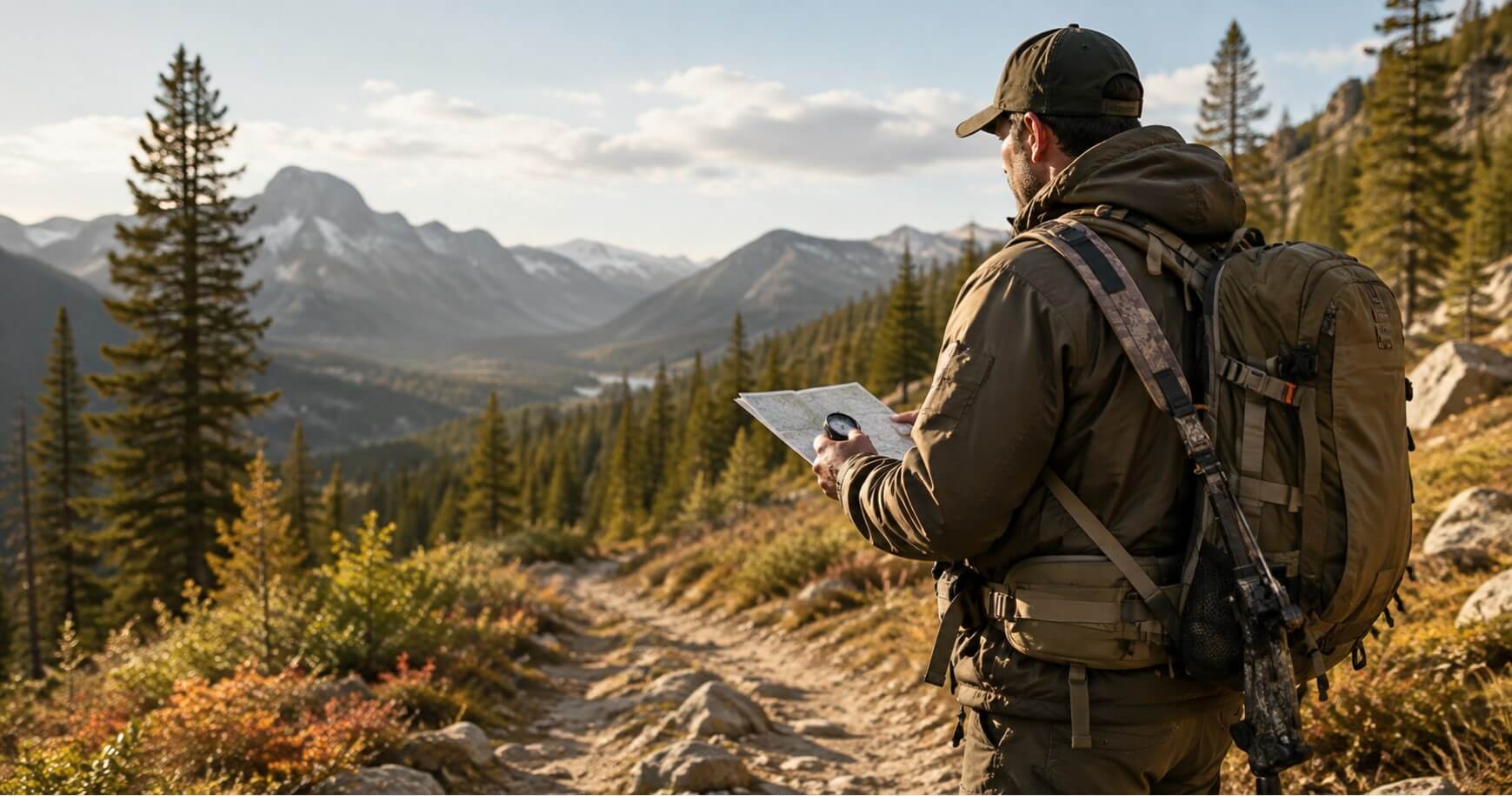
Clothing and Protection
Base layer — The first layer of clothing worn next to the skin.
Example: A dry base layer helps you stay comfortable in cold weather.
Outer layer / shell — The clothing layer that protects you from wind or rain.
Example: Put on your waterproof shell before the rain gets heavier.
Insulated — Made to reduce heat loss.
Example: She packed an insulated jacket for the early morning.
Water-resistant — Able to resist some water, but not necessarily completely waterproof.
Example: These boots are water-resistant, but I would not wear them in deep water.
Camo / camouflage — Colors or patterns designed to help a person or object blend into the surroundings.
Example: His camo jacket matched the brown and green vegetation.
Navigation and Terrain
Trail — A path through a natural area.
Example: The main trail continues past the lake.
Trailhead — The place where a trail begins.
Example: We agreed to meet at the trailhead at six in the morning.
Terrain — The physical features and condition of the land.
Example: The terrain becomes rocky near the top of the ridge.
Ridge — A long, narrow area of high ground.
Example: Strong wind was blowing across the ridge.
Creek — A small stream.
Example: We crossed the creek where the water was shallow.
Waypoint — A selected location used for navigation.
Example: Save the parking area as a waypoint before you leave.
Bearing — A direction measured with a compass.
Example: Check your bearing before moving away from the marked trail.
Useful Action Verbs
Adjust — To change something slightly so it fits or works better.
Example: Adjust the strap until the weight feels balanced.
Secure — To fasten something so it cannot move or fall.
Example: Secure every loose item before crossing the creek.
Attach / detach — To connect something / to remove it from what it is connected to.
Example: Attach the pouch to the outside of your pack.
Tighten / loosen — To make something tighter / less tight.
Example: Loosen the belt when you stop for a break.
Carry — To hold or transport something from one place to another.
Example: We carried extra water because the day was unusually warm.
Pack — As a verb, to put items into a bag for a trip.
Example: Pack only what you expect to use.
Common Phrases You May Hear Outdoors
- “Travel light.” — Carry only the things you really need.
- “Keep it within reach.” — Put an item where you can get it easily.
- “Watch your footing.” — Be careful where you place your feet.
- “Stay on the trail.” — Do not leave the marked path.
- “The weather is turning.” — The weather is beginning to change, usually for the worse.
- “We are losing daylight.” — There is not much time before sunset.
- “Let’s head back.” — Let us return to where we started.
- “Gear up.” — Put on or prepare the equipment needed for an activity.
Sling, Strap, and Belt: What Is the Difference?
These three words are related, but they are not always interchangeable.
A strap is the most general word. A backpack strap, watch strap, or camera strap can all be called a strap.
A sling is a type of strap or support system made to carry a particular object across the shoulder or body.
A belt usually goes around the waist, although equipment belts can also hold tools and pouches.
Compare these examples:
- The backpack has two padded shoulder straps.
- The crossbow is supported by a sling.
- A small pouch is attached to his belt.
Practice Exercise
Choose the best word for each sentence: terrain, secure, trailhead, sling, insulated.
- We met at the ______ before sunrise.
- Please ______ the loose equipment before we start walking.
- The rocky ______ made the final mile difficult.
- He carried the crossbow with a padded ______.
- An ______ jacket helps reduce heat loss.
Answers
- Trailhead
- Secure
- Terrain
- Sling
- Insulated
Final Tip
Do not try to memorize every term in one sitting. Choose five words, write your own examples, and listen for them in an outdoor video or product review. Vocabulary becomes easier to remember when you meet it in a real situation rather than as an isolated list.